This month, the Academy of Nutrition and Dietetics wants you to get personal about your food choices. Why? Because they say knowing and embracing your individual food style and preferences is one of the best ways to eat a healthy diet and make good food choices over the long term. In short, they think our favorite foods – foods we like and feel excited and satisfied by – should be a part of our life.
Can we can really be healthy and still celebrate our diverse food preferences? The experts behind National Nutrition Month® say we can. National Nutrition Month® is a nutrition education and information campaign created annually in March by the Academy of Nutrition and Dietetics, an organization of food and nutrition professionals. This year marks the 40th anniversary of National Nutrition Month®, and Eat Right, Your Way, Every Day is this year’s theme. The theme provides a positive platform to think about eating in terms of individual choices – our traditions, our lifestyle, and our likes and dislikes. While the emphasis of National Nutrition Month® is on portion size and moderation as part of a healthy eating plan, this year’s theme also focuses on the idea that eating healthily doesn’t mean giving up foods that we love, foods that we grew up with, or foods that are part of our culture or lifestyle.
For example, rather than making our traditional Italian pasta dishes or Southern specialties off-limits, modifying or moderating our portions of these beloved foods can put us on the road to a healthy diet, as long as we follow the principles of good eating outlined by the USDA’s MyPlate recommendations – filling half our plate with fruits and vegetables and understanding the food groups and portions that make up a healthy diet. Whether we are athletes or mothers, vegans or meat lovers, the idea behind Eat Right, Your Way, Every Day is that eating what suits us personally can help us eat well.
Learn more about principles of National Nutrition Month® and Build a Personalized Eating Plan, or visit EatRight.org for a variety of tips, games, and educational resources designed to spread the message of good nutrition.
Be Part of the Conversation About Healthy Eating
What are your personal eating habits?
We all balance our lifestyle, traditions, and health needs in different ways. Who we are and how we live dictates what we choose to put on our plates every day. Be part of the conversion about how you eat and live – write about it on your own food blog and be listed on the National Nutritional Month® Blogroll. Or, let us know by commenting or sending us an email. We want to hear your insights during the month of March. Then, we’ll share your answers or your posts with our readers.
Use these questions as a guide:
How is your family or cultural tradition part of your everyday eating?
What parts of your lifestyle dictate what you eat? Are you away from home a lot? Do you care for other family members?
What part of your food choices are dictated by what you love to eat?
What personal food choices do you feel good about? Not so good about?
Celebrate your individuality this month! Make your food choices healthy ones by putting something you love on your plate. Then share the love by being part of conversation about healthy eating.
Have You Entered to Win a Wild Taste Adventure?
You’ll have a chance to win Five Days of Food and Fun in the Land of Wild Blueberries, a getaway which includes transportation for two to Québec City, Canada, 4 nights lodging in the historic Château Frontenac, and a $1,000 Wild Taste dining allowance to enjoy the Wild Blueberry specialties in top restaurants around the city! Just enter for a chance win this Wild Taste Adventure!
Have a Wild Taste Adventure in the Land of Wild Blueberries
February is the perfect time of year to dream about an exciting, relaxing vacation full of plenty of first-class cuisine and exploration in one of the most magical provinces in the world. It’s even better when the vacation is free and planned just for you. This one could be: all you have to do is enter for a chance to win.
What’s the Wild Taste Adventure Sweepstakes all about? It’s about embracing your love for wild blueberries in the land of wild blueberries – Québec City. In Québec, Eastern Canada and Maine, the wild blueberry is beloved for its robust annual harvest that provides people all over the world with this nutritious, delicious antioxidant superfruit all year long.
You could enjoy transportation for two, 4 nights lodging at the historic Château Frontenac, and a $1,000 dining allowance so you can truly enjoy the city’s culinary delights. It’s a perfectly delicious getaway!
Ready for a chance to win a holiday of food and fun in the land of wild blueberries? Entering is easy:
1. First, watch the video and get a taste of why this little berry gets big love from chefs and food lovers alike. 2. Then, peruse some of the celebrated restaurants you’ll encounter on your trip, including L’Echaudé, Bistro L‘Atelier. L’Espace MC Chef and the Château Frontenac. You’ll learn about these restaurants’ amazing chefs and their delicious wild blueberry dishes, and find recipes for exotic cocktails, local favorites, and unique confections.
3. Last, Enter the Sweepstakes! You could be saying Bon voyage and Bon appetit before you know it if you’re the winner of the Wild Taste Adventure in Québec City!
“Shoulder season” is known to many in Maine and the Atlantic Provinces as the season to say goodbye to the last fresh local pint of wild blueberries. It refers to the time just after the height of the harvest and before the annual move into winter, and it marks a transition for growers and for the market as summer crops disappear and alternative sources take the place of local ones.
On the fields, the month of September ushers in a new phase of work. Barrens still bustle, but much less than they did during the demanding days of late August. Farmers use the month to clear weeds, clean farming equipment, and mow this season’s fruit-bearing plants – they will be next year’s unharvested ones, fitting with the two-year cycle of production that dictates only half of the fields are harvested each year while the other half regenerates.
In milder, coastal regions, September is still the season of fresh: wild blueberries can be found until mid-month in some areas. But for most of us, local sources for fresh summer produce are replaced with non-local alternatives when fall comes. The good news is if you live in Maine and parts of Canada and enjoy fresh local wild blueberries during the summer, you can still find the tasty locally sourced wild blues in your grocery store’s frozen aisle. Producers in the two nations work together with distributors to provide the indigenous frozen fruit throughout the winter months to those of us who live here and to consumers all over the country, ensuring that we always have plenty of uniquely delicious, powerfully nutritious berries for the entire year at our neighborhood market.
It’s sad to see them go – but it’s fortunate that we can still enjoy wild blueberries long after we have picked or purchased our last fresh pint. In fact, there are some important reasons why entering the season of frozen isn’t as bad as it might sound.
You Say Flash, I Say Quick, Let’s Call the Whole Thing IQF
Maybe you call it frozen-fresh. Maybe you say quick-frozen, flash-frozen or IQF. Either way, all terms refer to the individually quick freezing method that takes fruit or vegetables at their peak of ripeness on the bush or vine and freezes them, so they are preserved at their height of freshness, nutrition, and taste.
While frozen used to be considered a second choice to fresh foods, today we know that frozen, in addition to being convenient and available year round, provides consistent quality and nutritional value. In fact, according to the FDA, frozen is equally as nutritious as fresh.
Freezing at peak locks in freshness and nutrients until we are ready to eat them. It means that we can choose from a variety of foods that taste as good and are as good for us as they were the day they were harvested.
For Nutrition, Frozen is “Fail Safe”
David B. Agus, a cancer doctor and researcher perhaps best known as the author of the New York Times bestseller The End of Illness, has been recognized for views that tend to push against traditional medical advice. He urges his patients to dispense with supplements, for instance, and rely on a strict daily schedule of sleeping and eating to reduce stress in our bodies that eventually leads to illness. He is also very vocal about the reliance on frozen, viewing it as one of the easiest ways to provide the nutrition we need to keep us living well and long.
Agus terms frozen “fail-safe” for consumers looking for a high concentration of nutrients. Frozen also allows us to choose from a variety of colors, which is the key to providing our bodies with the best nutrition and disease prevention, without relying on what has just come into the store or what is in season.
In The End of Illness, Agus also points out that frozen fruits and vegetables are immune to the degradation that occurs after food is picked, during transport, on the grocery store shelf, or in our own kitchen. With frozen, there’s no need to worry about using items quickly before they expire or “go bad” – they are always ready to eat, providing the same nutrition and taste whenever you use them.
Choosing the best foods we can is crucial to maintaining good health and fighting disease. To complicate matters, our choices must counteract the shortcomings of the processed, nutrient-poor food that for us as Americans is readily available. While most of us know that accomplishing that means a visit to the produce section, availability can be a challenge well after shoulder season has come and gone.
Local fresh fruits and vegetables just harvested in season are wonderful. We are lucky to enjoy their bounty at farm stands and farmer’s markets each year. But make no mistake: the frozen food aisle is a section of the supermarket that also bursts with life-lengthening, disease-preventing nutrition in a stunning array of perfectly preserved color stopped in time at its peak of perfection. Once we stop seeing frozen as a bastion of processed snacks and TV dinners and start seeing it for what it is, we’ll begin making food choices that will change and lengthen our lives – during the height of the summer and the depths of the winter.
So while it’s OK to lament the passing of the summer warmth and vacations, we can still celebrate shoulder season. For those of us who love wild blueberries and rely on them for our health, thanks to frozen, it’s simply a time of seamless transition.
How do I substitute frozen for fresh?…Should I thaw before using?…How do I prevent batter from turning blue? Get answers to these and other popular questions about cooking and baking with frozen wild blueberries at FAQ Blue.
Have fresh wild blues you’d like to freeze? For some, freezing fresh berries using a baking sheet and a zipper-bag is a shoulder season tradition!
Sunny Jennings shares plenty of wonderful dishes on her blog Tantra Cooking. Tantra, a method of cooking that puts the focus on the process of making the meal, allows us to combine our passion for whole, healthy food with the personal relationships that truly sustain us. Jennings says wild blueberries are her favorite fruit, and calls them “naturally sweet and perfect.” This week, she shares her New England memories of wild blueberry picking and cooking, exclusively with Wild About Health.
I REMEMBER EVERYTHINGabout living in the hills of New England through a rosy glow of nostalgia, especially summers, my many, wonderful girlfriends and blueberry season.
We all anticipated wild blueberry season and would begin getting together our recipes weeks ahead. Old recipes had been handed down through the families, new ones were usually clipped from Yankee Magazine and many were experimental works in progress. While we ate blueberries every day of the season, one day each August my friends and blueberries came together. It was magic.
Although I lived in the verdant hills far from a city, I was blessed to live in a neighborhood with other houses nearby. Most had women near my age and all were wonderful cooks or bakers. Each year, we would plan a morning hike on our closest mountain. We carried empty bags up the mountain and brought back down bags filled with wild blueberries for an all-afternoon baking event. Often, it rained on those mornings, which only seemed to make the event even more special. Picture us: no make up, hair yanked back under baseball caps, blue teeth and tongues, wet clothes and muddy boots. Yes, these are the girls gone wild for blueberries.
While I routinely used blueberries all kinds of ways, that day was dedicated to deserts and lots of sugar!
Sunny Jennings, “The Tantra Cook”
We each had several quarts to work with and the six kitchens closest to one another became a communal culinary site. We cooked that way for other large events, however, one Saturday each August, we created the largest wild blueberry test kitchen on the planet. Or, so we told ourselves. We told stories, caught up on our news, laughed, experimented, carefully or casually measured ingredients, shared equipment and gently critiqued each creation as it reached its optimal temperature. We loved our time together, and each of us carried timers hooked to our waists to remind us to race back and check on whatever was in the oven or refrigerator. Amazingly, we never lost a dish to inattention. Hot crumbles and crisps, warm pies, cakes and chilled trifles, came out beautifully as the native girls passed their generations of family knowledge on how to work with wild blueberries. For one day each year, we didn’t worry about whether our jeans would zip the following week and delved into pure yummy.
None of us had secret ingredients or recipes we refused to share. That isn’t the New England way, and we were all about helping one another develop even better recipes.
Now that I no longer live there, I keep my eyes open for wild blueberries, and I’m thrilled to have found them at better produce outlets. Not only do they allow me to feel connected to my wonderful friends in New England, but each is a sweet gift of flavor as it bursts in my mouth. It’s easy to forget how healthful they are! Over the years, I’ve cut back on the mountains of sugar we used during our blueberry baking marathons. Fortunately, blueberries don’t actually need sugar to sweeten them. They are naturally sweet,
naturally perfect.
We all have our favorite pie and crumble recipes, so today, I’ve included an updated recipe that is so healthy, I can enjoy it nearly every day. It’s a Wild Blueberry and Quinoa.
Most of my girlfriends from the gym begin their days with Greek yogurt, granola and blueberries. That’s a great start before our workouts. I’ve switched over to this quinoa recipe, which has the added benefit of Omega-3s. Also, the use of honey and walnuts reminds me of wonderful Greek deserts.
By cooking the quinoa the night before, I can assemble the dish, eat and get in half a workout before I wake up!
The term “rick” is in rare use today. It is most likely to be heard from the mouth of an “old timer” from Washington County referring to the long space between two lengths of twine that designates a raker’s area on the barrens. Sometimes you are lucky to get a “good rick” or unfortunate enough to have to rake a “bad rick”. The “bad ricks” are usually the start of the fields or near the woods. Today, most people refer to the section simple as a “row”.
Thanks to Todd Merrill of Merrill Blueberry Farms in Hancock Country for this information and for confirming my recollection of this term. –Ed.
Sunny Jennings, known by many as The Tantra Cook, was kind enough to share her own childhood memories of living in New England and picking wild blueberries — what she calls her favorite fruit — in the nearby hills. She also shares a favorite recipe.
On The Tantra Cooking Blog, Sunny joins her culinary passion and a penchant for fun with “Tantra Cooking,” a method of putting the focus on the process of the meal, from beginning to end. That might mean shopping for ingredients with the kids, chopping veggies with a girlfriend or chatting with family over the grill. It’s a wonderful approach that lends itself to choosing whole ingredients and helps us rely less on food short cuts that undermine our health. You Go, girl! Here’s a preview of her post for Wild About Health:
“…one Saturday each August, we created the largest wild blueberry test kitchen on the planet. Or, so we told ourselves. We told stories, caught up on our news, laughed, experimented, carefully or casually measured ingredients, shared equipment and gently critiqued each creation as it reached its optimal temperature. We loved our time together and each of us carried timers hooked to our waists to remind us to race back and check on whatever was in the oven or refrigerator.”
— Sunny Jennings
Relied-Upon Recipe Classics for a Wild Season
The season is ON! Use your fresh while you can in these Maine favorites this weekend.
The 37th Annual Machias Wild Blueberry Festival is Just a Week Away, and It’s Bringing Pies, Art, Music (and a Wedding!) to Down East Maine.
Nobody knows how to celebrate the wild blueberry harvest like the people of Down East Maine. Get ready to celebrate it with them! In Machias, residents like to say they “roll out the blue carpet” each August and this year is no different. The 37th Annual Machias Wild Blueberry Festival takes place August 17-19, so it’s time to make your vacation plans to head Down East. Here are some of this year’s highlights:
Blueberry Farm Tours – Learn how low bush wild blueberries are harvested, what it means to “rake” blueberries, and how a mechanical harvester works at a working farm. Weekend shuttle service is available from town.
The Blueberry Pie-Eating Contest – Contestants are chosen by lottery for this highlight of the festival that is fun to watch and to try. View these photos from previous years and judge for yourself.
The Blueberry Musical – A musical romp that features a different script every year and lots of local talent. This year’s theme, East Side Story, is certain to deliver with raucous music, choreography and wild antics.
7th Annual Blackfly Ball – This wacky dress-up dance party is as much crazy booty-shaking as it is celebration of a piece of community history. A much-anticipated family event.
Crafts & Artisans – Plenty of crafted wonders are on display this year including pottery, sea-glass, jewelry and smoked salmon.
ALSO: Cooking contests, a flea market, a road race, a parade, and on Sunday two Blueberry Festival Co-Chairs will wed on the steps of the Centre Street Congregational Church! What a way to celebrate!
If you want a taste of the wild blueberry harvest, do it in a town that holds the little blue fruit dear – after all, it put Down East Maine on the map! There is no admission fee, so come and enjoy and stay locally.
Have you entered to win a 5-Day Coastal Adventure? Bar Harbor is just a half an hour away from Machias, and this Sweeps is a chance for you and a friend to go wild in the land of wild blueberries with a 5-day expense-paid getaway at the Bar Harbor Inn. It’s filled with amenities, such as lobster dinner, spa, tours, and more. Enter for a Chance to Win!
What is surprisingly small, startlingly tasty and only around once a year? It’s lowbush blueberries (known widely as “wild ”), available in Maine and Nova Scotia exclusively during the special weeks of harvest season. If you live in the region, you’re lucky – you can enjoy one of nature’s most sensational gifts fresh from the field. They bring joy to our taste buds and to our bodies in equal measure, thanks to unsurpassed antioxidant power. It’s nearly time to engage in the tradition of picking, buying, cooking, and eating wild blueberries during the few weeks a year they burst in a sea of blue from the fields.
Wild By Nature
What’s so special about wild? You can easily get the scoop on wild blues from anyone in Northern Maine. Blueberries grown there are not planted from seed or transplanted – they are wild, created by bees transferring pollen. One acre of plants typically contains over one hundred varieties, each genetically distinct, providing that characteristic diversity of flavor. While cultivated berries – larger berries not sold under the moniker of “wild” – have just over 100 varieties, there are an estimated 6.5 million wild blueberry “clones” or varieties of wild blueberry plants. They flower into a superior sweetness that delivers superb disease fighting compounds: the deep violet skin that provides protection as they bask in the harsh summer sun is transferred to our own bodies to fight disease and aging when we eat them. There are more fresh wild blueberries in a cup, pint, or serving than cultivated, too, because of their size (approximately 150 vs. just 90 according to Virginia Wright, author of The Blueberry Book), meaning more antioxidant power is delivered via the higher ratio of deep blue skin.
Today, farmers with acres of wild blueberry fields are preparing for the harvest, which occurs around the last week in July and lasts through mid-September. Right now, crews are beginning to arrive to process the berries from the fields – over 200 million pounds will be harvested in the growing areas during this time. While the majority of the harvest is frozen, a chosen few remain fresh and appear in local markets and on roadside farm stands. Fairs and festivals will commence, celebrating the season with berry-focused events, and menus around New England will feature wild blueberry-themed dishes. It’s a special time, and it takes place only in a special place, and that time is here.
“Fresh!” A Special Request
Even with IQF freezing that preserves all the nutrition and taste of fresh for our enjoyment year-round, eating fresh blueberries from cardboard containers has a special allure for local residents. It truly connects us to our foods origins, reminding us that wild blueberries are a special treat indigenous to our area and facilitated by local farmers who have worked their fields for generations. Eating fresh blues also allows us the opportunity to better savor each berry, assessing their individual tastes – one sweet, one tangy, one jammy, one tart – and the mixture of under- and overripe berries that mix to create an unduplicated complexity of flavor that can only be found in nature in late summer.
Fresh wild blueberries also provide a tradition of picking (or just picking up from your local market or roadside stand) and reveling in brimming pints stacked and ready for snacking and cooking. For many families in Maine, it’s a rite of passage – a tradition that is passed down through generations that comes to define summer in a region that holds the season itself and its bounty dear.
July is National Blueberry Month (Naturally!)
Even for those who don’t live in the region, it’s time to eat blueberries. Here, we eat them fresh at every meal, in every dish. Head to local fields to pick your own and start a summer tradition if you don’t have one. You can find pick-your-own wild blueberry fields in Nova Scotia or search for them in Maine by region. Then, bring your plenty home and get creative. You can do anything from grilling them to having them the more conventional way – by the forkful in a heavenly blueberry pie or blueberry turnover (like these from Plating Up). Sprinkle and scoop them onto anything and everything: cereal, yogurt, salsa, sandwiches, entrees and ice cream. It’s no time to be conservative. Indulge in this wonderful gift of nature while you can.
When you’re done picking, local restaurants will offer you respite. Menus are bursting with blue in the summer to pay homage to the season. Chefs feature freshly harvested blues in an array of seasonal dishes ranging from crisps and brûlée to decadent entrées where blueberries complement the flavors of the main course. Just browse the menu of your favorite local bistro, café, eatery, or bakery, or take a look at what some Maine chefs do with wild blueberries by viewing the videoWild Blueberries – A Culinary Star.
Capture the Wonders of Blue This Season
Want to capture those glowing, picturesque fresh wild berries during this fleeting season? There are plenty of mouth-watering ways. Share your fresh sightings and gastronomic wonders far and wide this year. Snap a photo and share it with your friends, on your favorite social network, send it to us, or pin it on your Pinterest page (or follow us on Pinterest to join the fun).
Here are some places you can find and capture the fresh wild blue essence before they are gone:
Need recipes for fresh wild blueberries? We have them! Bookmark wildblueberries.com so you’ll be ready, or follow us on Facebook for the latest recipe ideas from around the web.
The Diabetes Expert Explains How Food Choices Lead to Big Changes
There aren’t a lot of people who believe in the power of healthy living as much as Daniel Nadeau, M.D. One reason? He’s seen it. As a clinician, in his work with patients, as Medical Director of the Diabetes and Endocrinology Associates of Maine’s York Hospital, and as an expert on the subject of diabetes, Nadeau has witnessed how simple choices can change – and save – a person’s life.
Nadeau often shares his expertise about the rise in lifestyle-related diabetes in local and national media. Here in Maine, he said, 3% of Maine population may have diabetes and not know it. “There are so many people that are heavy and getting a heavier. It’s a major problem,” he told Wild About Health. “If someone is obese, their risk of developing diabetes is twenty- to fortyfold higher.” For many of his patients, their diagnosis is a wake-up call.
Recently he saw a patient – a man in his mid-30s – who had developed Type 2 diabetes that was out of control. The man lived a sedentary life in a sedentary job, and he made all the wrong food choices, eating a daily diet of burgers and fries – in other words, standard American fare. He was facing grave consequences if he didn’t change.
Talking to Nadeau got the message across. His patient started eating healthy and exercising. He dropped 35 pounds, and his blood sugars returned to normal. “He has a new lease on life,” said Nadeau. “When you make real change, you make real differences.”
Quieting the Storm Within
As a kid growing up in Fort Kent, Maine, Nadeau ate a typical diet heavy on meat and dairy. But it wasn’t long before he developed an atypical interest in health and wellness. In high school, he opened “Nadeau’s Natural Food”, a health food store that he ran all through college. He read all the books he sold, and his thinking about food began to change. “One week I read Adelle Davis, the next week I read Sugar Blues, the next week I read Macrobiotics, another week I read Ann Wigmore and about the Raw Foodists. Every week I had a different diet.” The more he read, the more his diet shifted. Even today, his approach to food is drawn from what he learned back then.
One of the missing elements of his food education was the story of color. Until he wrote The Color Code: A Revolutionary Eating Plan to Optimum Health with James Joseph in 2002, the powerful role of incorporating color into the diet was not on even the most informed consumer’s radar. The Color Code directly influenced efforts such as the 5-A-Day program, which encouraged people to get five servings of fruits and vegetables (that recommendation has now changed to 8-10 servings) and helped consumers understand the important nutritive benefits of pigmented foods.
Plants, which live in a sea of destructive ultraviolet light, depend on pigments to protect themselves from solar irradiation and the inflammation that would result from their exposure. When we eat those pigments, we pass on the protective elements to our bodies, reducing inflammatory markers and protecting ourselves from chronic disease, including Alzheimer’s and brain disease, joint disease, risk of myocardial infraction, and diabetes, among other inflammatory conditions. According to Nadeau, “If we can reduce the inflammation in our bodies by eating fruits and vegetables, we are not only protecting ourselves from these conditions, but we are protecting ourselves from aging itself.”
That brings us back to the issues of diabetes. Type 2 diabetes is the most common form of diabetes in America today. People with diabetes have more Alzheimer’s, more cancer, more vascular disease, increased inflammation, and accelerated aging that leads to complications of the kidneys, nerves, eyes and many other parts of our bodies. People with diabetes have a threefold increased risk of having a heart attack as well – the same risk as someone who has already had a heart attack.
Much of one’s risk of Type 2 diabetes depends on their being overweight. When we’re overweight, our body releases more free fatty acids and our insulin doesn’t work as effectively. Not only are we capable of changing this, said Nadeau, but we can change it on day-to-day basis based on the choices we make about food and exercise. People with diabetes are contending with a body that is full of inflammation, and by making different food choices, they can begin, he said, to “quiet the storm within.”
Rethinking Diet
While he doesn’t evangelize, Nadeau believes veganism can be one way to quiet that storm. As a vegan, Nadeau said his diet is naturally more diverse. “As opposed to having a hamburger and fries one night and macaroni and cheese the next, you are tending to pull in all these different brightly colored fruits and vegetables. You tend to cook different things and you tend to explore more,” he said. He favors veganism for those facing dire health circumstances due to diabetes not just because the diet is healthy, but because it presents a new way to approach food to people struggling with change. A vegan diet enables them to truly rethink what they eat at a time in their life when change is critical.
“People don’t realize in terms of preventing and treating the chronic diseases we face that the benefit really comes from plants,” said Nadeau. While veganism eliminates dairy and red meat, two things he recommends avoiding, reliance on plants is its most important characteristic. Even just a move toward incorporating more plant foods is a good start, he said. For some, that may mean making vegan choices a few days a week, or trying to eat vegan two out of three meals a day.
Adopting a healthy diet in the face of fast food conglomerates and limited options for vegans when it comes to eating out is definitely challenging. “But veganism is something that still has some cachet,” Nadeau said. “I don’t believe it has reached its peak in terms of interest.” He blames the Atkins craze for setting the world of healthful eating back dramatically and considers the country to be in “recovery mode” from the phenomenon. Whether it is because of health, the animal world, or climate change, he believes it is a time of increased awareness of the consequences of our food choices and that more and more people are beginning to eat with consciousness.
Toward a Healthier Meal
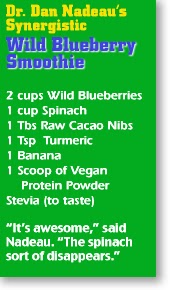
“I ask people to take each meal at a time and look at what they are going to eat,”said Nadeau.“Ask yourself, is this the healthiest way I can eat this meal?” His dietary convictions weave through the books he currently has in development. One focuses on diabetes, another on raising healthy kids, and another on healthy living and weight loss. One secret weapon he gives patients is the wild blueberry smoothie. “Most people like berries, and they don’t have a hard time incorporating a smoothie for breakfast. They end up loving it, and they find it doesn’t spike their blood sugars. It’s a great way to start the day.” (His own smoothie recipe, shown in the sidebar, doesn’t skimp – it contains a full 2 cups of wild blueberries.) Wild blueberry smoothies also provide excellent synergy. By combining different antioxidant foods, he says, it creates a synergistic relationship that makes the foods even more powerful than they would be if they were eaten alone: “Combining berries with something green, with raw cocoa and with turmeric, another amazing antioxidant, you are protecting yourself before you walk out the door.”
Hear Dr. Nadeau on the Power of Blue:
Nadeau recommends a diet generally high in blueberries especially for patients with diabetes. Wild blueberries are low in calories and low in carbs, and for those with kidney problems, often associated with diabetes, blueberries are a good choice because they have moderate levels of potassium.
For those who eat meat, he advises eating more fish, turkey and chicken, and avoiding sugar, white flour, beef, cheese and ice cream, while focusing on whole grains and legumes in addition to fruits and veggies. He also recommends eating more raw foods. “Blueberries are gong to be better for you if you have them raw or frozen, as in a blueberry smoothie, than they are if they are cooked,” he said. His ideal way to eat food is to allow the cells to release glutens through brief exposure to heat for maximum nutritional absorption – for example, spinach that instead of being cooked merely “kisses” a hot grill.
While forgoing comfort foods is simply out of the question for some, when people begin to connect with the idea of healthy eating, Nadeau witnesses remarkable transformations in terms of their body weight, blood sugar control, and how they feel, just like his 30-year old patient. Are the rest of us embracing this important connection between our choices and our health? “People need to hear from somebody,” he said. “They realize the connection when they get done talking to me.”
The 2012 TEDMED Conference, modeled after the famed TED talks, gathered thinkers and doers from around the world this past April to share exciting ideas and innovations in the fields of health and medicine.
Some videos from the conference, which was held at the Kennedy Center in Washington DC and streamed live to audiences nationwide, have been made available to the public so an even wider population of people can take part in the presentations that addressed issues affecting all Americans, including innovations in disease prevention and cure, health care considerations and management, and pioneering ideas in diagnostics, genetics, medications and social issues.
If you are a health and medicine geek, you’ll want to browse the topics of these dynamic talks. Here are just some of the videos now online with ties to some of Wild About Health’s most talked about topics:
Judith Salerno & John Hoffman talk about the consequences of the obesity epidemic.
David Kirchhoff, the CEO of Weight Watchers talks about living and coping with today’s new “obsogenic” environment and why obesity isn’t about eating too much.
Franziska Michor investigates how to use math to decipher how cancer grows and how we can computationally crack the cancer code.
And there’s plenty more from this year and past years, including videos with Lance Armstrong, Dr. Oz and others. (Check out Calvin Harley and Elissa Epel’s 2011 presentation on how psychological stress causes our cells to age.)


 Can we can really be healthy and still celebrate our diverse food preferences? The experts behind National Nutrition Month® say we can. National Nutrition Month® is a nutrition education and information campaign created annually in March by the Academy of Nutrition and Dietetics, an organization of food and nutrition professionals. This year marks the 40th anniversary of National Nutrition Month®, and Eat Right, Your Way, Every Day is this year’s theme. The theme provides a positive platform to think about eating in terms of individual choices – our traditions, our lifestyle, and our likes and dislikes. While the emphasis of National Nutrition Month® is on portion size and moderation as part of a healthy eating plan, this year’s theme also focuses on the idea that eating healthily doesn’t mean giving up foods that we love, foods that we grew up with, or foods that are part of our culture or lifestyle.
 For example, rather than making our traditional Italian pasta dishes or Southern specialties off-limits, modifying or moderating our portions of these beloved foods can put us on the road to a healthy diet, as long as we follow the principles of good eating outlined by the USDA’s MyPlate recommendations – filling half our plate with fruits and vegetables and understanding the food groups and portions that make up a healthy diet. Whether we are athletes or mothers, vegans or meat lovers, the idea behind Eat Right, Your Way, Every Day is that eating what suits us personally can help us eat well.
 We all balance our lifestyle, traditions, and health needs in different ways. Who we are and how we live dictates what we choose to put on our plates every day. Be part of the conversion about how you eat and live – write about it on your own food blog and be listed on the National Nutritional Month® Blogroll. Or, let us know by commenting or sending us an email. We want to hear your insights during the month of March. Then, we’ll share your answers or your posts with our readers.